News

The Berry Patch Pioneers Innovative Use of Exclusion Netting to Combat SWD

Berry Patch stephentown exclusion netting blueberries new york state berries

The Berry Patch Pioneers Innovative Use of Exclusion Netting

to Combat SWD

The Berry Patch, in tiny, rural Stephentown, has pioneered an innovative solution to spotted wing drosophila (SWD) infestation. Since it arrived in the United States in 2008, SWD has made it virtually impossible to grow commercially acceptable, pesticide-free raspberries and blueberries, but the Berry Patch’s experiments with exclusion netting seek to end crop losses.

Spotted wing drosophila is native to Southeast Asia. It first appeared in California in 2008, and spread to Florida the following year. By 2010, SWD had migrated to the Carolinas, Louisiana, Utah, Michigan, and Wisconsin. Northeastern fruit growers first went to battle with the insect in 2012, when an average of 80% of raspberry and 30% of blueberry crops—and approximately $4.3 million in revenue in NY state alone—were lost due to infestation of the fruit during its early ripening stages. Dale-Ila Riggs, co-owner of the Berry Patch and NYSBGA board chair, says, “This pest is a game-changer for berry growers nationwide. There are no natural enemies for it in the U.S.”

In 2012, Riggs lost about 40% of her lucrative blueberry crop to SWD. After observing some early research on the use of exclusion netting at Cornell University’s New York State Agricultural Experiment Station in Geneva, she obtained a Northeast Sustainable Agriculture Research and Education Farmer grant to test the use of the netting on her half-acre blueberry planting. Riggs adapted her existing bird-netting support system into a support system for the exclusion netting, with extra protections and anchoring to withstand thunderstorms, hail, and up to 60 mph winds. She then compared the fruits from the covered plot to the fruits grown in a control plot protected only with bird netting.

Berry Patch co-owner Dale-Ila Riggs adapted her existing bird netting structure to exclusion netting, with extra security features to help it withstand the volatile Northeastern climate.

Berry Patch co-owner Dale-Ila Riggs adapted her existing bird netting structure to exclusion netting, with extra security features to help it withstand the volatile Northeastern climate.

The results were startling. Riggs documented an infestation rate of 0.7% and 0.3% in 2014 and 2015, and last year had a 0% infestation rate—a rate virtually unheard-of in agricultural systems.  Other farms around the country are taking notice, and have started to duplicate the Berry Patch’s successful growing system.

Riggs will set up her blueberry exclusion netting again in early July, prior to SWD’s summer activity. She also plans to experiment with the same exclusion netting for her high-tunnel raspberry planting for the first time this year. “With SWD, no one has been able to grow pesticide-free berries that are free from infestation,” Riggs notes. “The netting makes it possible. This is a highly effective method that brings new hope for growers.”
 

Doing “Nearly Everything Wrong”: A West Coast Farm with Northeastern Techniques

New York Times strawberry article New York State Berry Growers

Doing "Nearly Everything Wrong":

A West Coast Farm with Northeastern Techniques

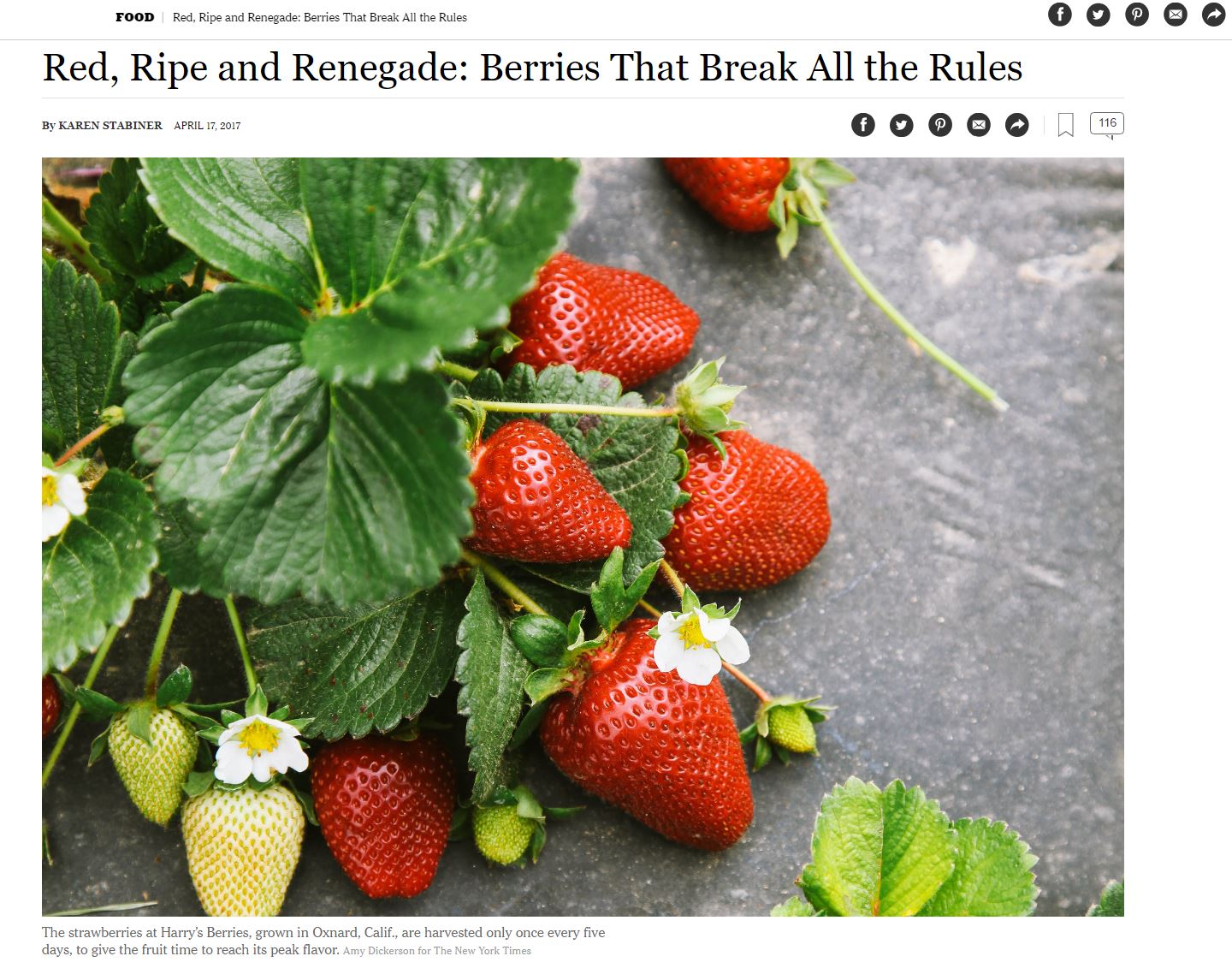
We’re always happy to see berries in the news, and we especially like to see stories that praise the growing and harvesting methods New York State growers have been using for decades. That’s why this April 17, 2017, story in the New York Times caught our eye.

The article, about Rick and Molly Gean, owners of the strawberry farm Harry’s Berries, near Los Angeles, touts growers who “do nearly everything wrong, at least according to the gospel of modern commercial berry farming.” The Geans started out with commercial strains of berries but now organically grow Gaviota and Seascape strawberries. They sell 500,000 pounds of berries per year, with 70 percent of their business at farmers’ markets; pints are priced at $8. The article states that Harry’s Berries are the preferred fruits of many West Coast chefs, and even a handful in the Northeast.

What’s most interesting about this article is the spotlight it shines on the Geans’ harvesting, which happens once every five days, to ensure peak ripeness. “Ripeness is all,” proclaims the piece. “When the berries run out, they run out, because the Geans would rather send a customer home empty-handed than with a berry that doesn’t meet their standards.”

While the article doesn’t acknowledge that New York’s independent berry growers have been harvesting only at peak ripeness for generations, this is a great talking point with customers. And while we may not have the advantage of year-round growing in a mild climate, our short season gives us the opportunity to highlight the berries as “limited edition,” available only for a few weeks a year. Keep a copy of the Times article in your farm store or at your market booth, and see if it sparks some important conversation.

The Health Benefits of Berries

New York State Berry Growers association health benefits of berries

The Health Benefits of Berries

Vitamin and Flavoid-packed Powerhouses

Beyond their ability to add flavor to and complement a variety of savory and sweet recipes, berries are vitamin- and flavonoid-packed powerhouses. Get to know more about each berry and how it can benefit your health.

Blueberry

  • Consistently ranked as one of the top antioxidant foods—twice the concentration of spinach, and three times the amount found in oranges and grapes!
  • High in vitamins C and K, and manganese
  • Good source of fiber
  • The newest research suggests that blueberries may reduce the risk of heart attack and be beneficial in halting age-related memory decline

Strawberry

  • Packed with vitamin C (one serving has 150% of the recommended daily value)
  • High in antioxidants
  • Good source of fiber, folate, potassium, and manganese

Blackberry

  • One of the earth’s strongest antioxidant foods, with high levels of polyphenolic compounds including ellagic acid, quercetin, and cyanidins
  • High level of fiber
  • High levels of vitamins C and K, manganese, and folic acid

Raspberry

  • Packed with fiber
  • High levels of vitamin C; vitamins B1, B2, and B3; magnesium, folic acid, and iron
  • High levels of antioxidants, including catechins, salicylic acid, and anthocyanins
  • Contain raspberry ketone, which some preliminary studies suggest may be helpful in weight control