
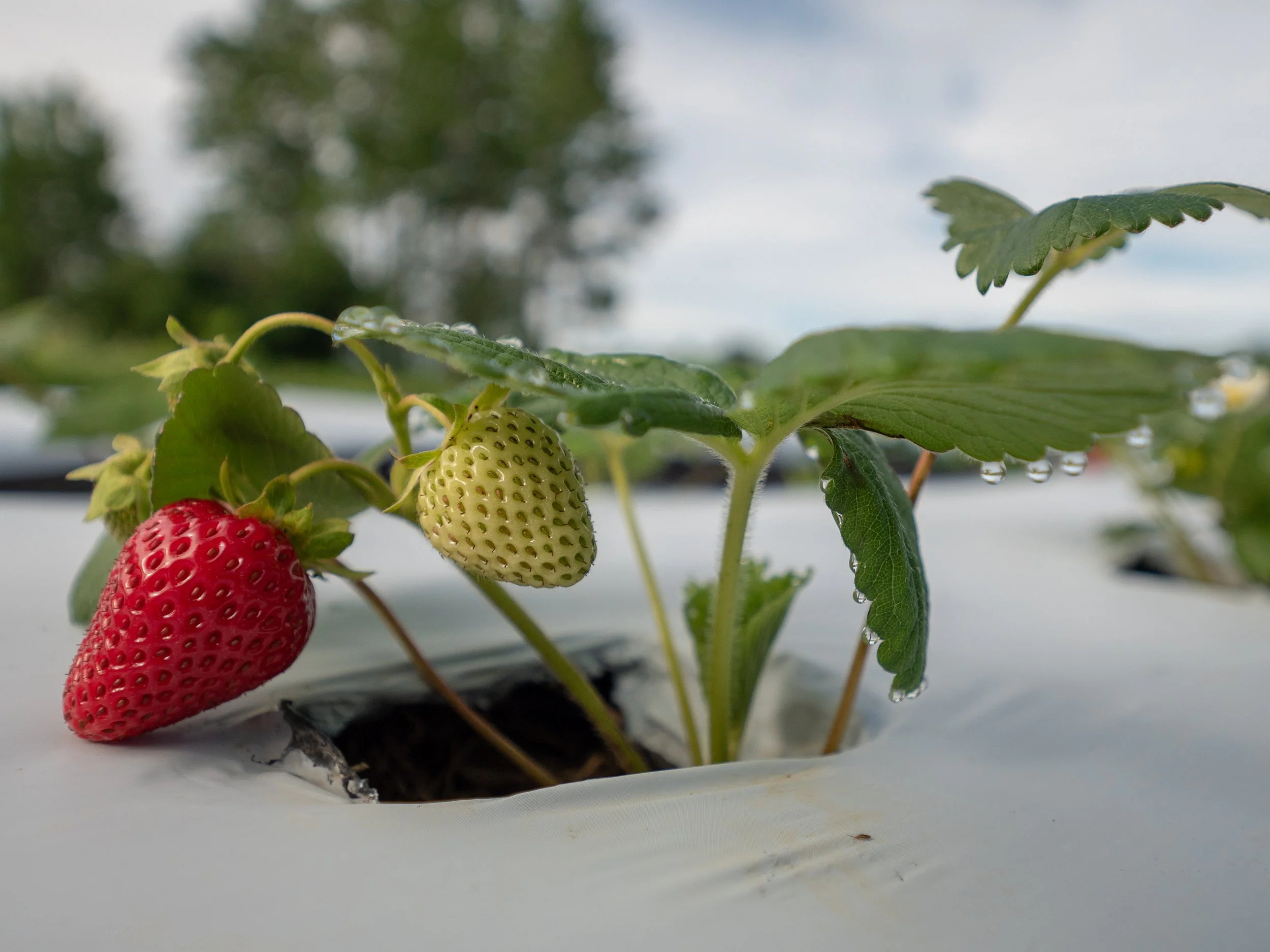
June-bearing strawberry renovation should be done as soon as possible after plants are done. Below is a guide for matted row and plasticulture renovation, respectively.
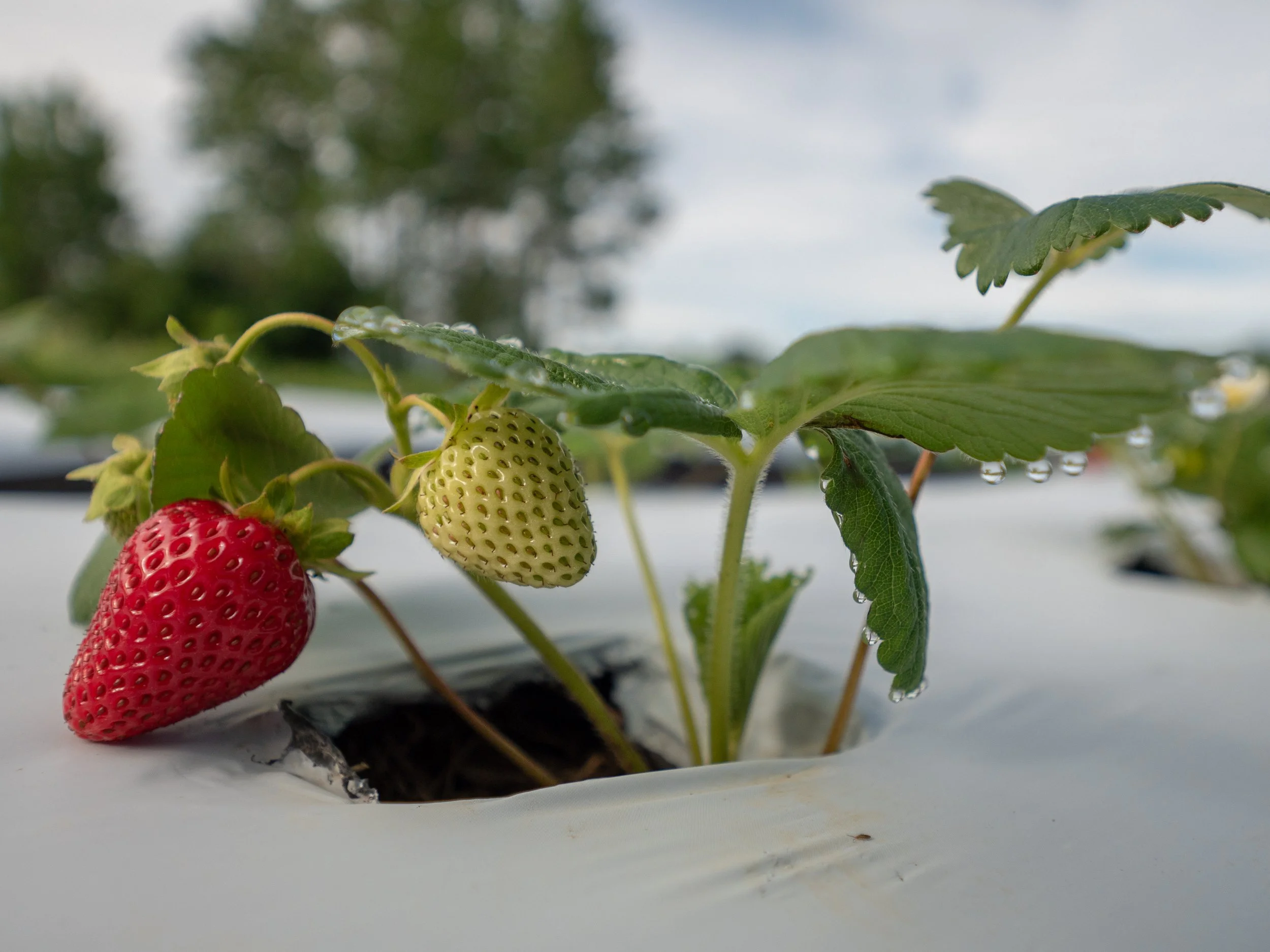
Matted-Row Renovation
Begin weed control. Annual broadleaf weeds should be controlled immediately after final harvest. Be extremely careful to avoid drift when applying 2,4-D. Some strawberry damage is also possible if misapplied. Read and understand the label completely.
Mow the old leaves off. Mow just above the crowns 3-5 days after herbicide application. Be careful not to damage crown by mowing too low.
Fertilize the planting. The main goal is to deliver nitrogen at this time to help re-grow the canopy. Nitrogen should be applied at 25 - 60 lbs./acre, depending on vigor and basic soil fertility. Split applications (one now and the rest in 4-6 weeks) are better than a single fertilizer application. This gives plants more time to take up the nutrients in the fertilizer. A leaf tissue analysis (recommended once the canopy has regrown) is the best way to fine-tune your fertilizer program. This will tell you what the plants are actually able to take out of the soil and what nutrients are in sufficient supply or not.
Subsoil. Where tractor and picker traffic has been heavy on wet soils, compaction may be severe. Subsoiling between rows will help break up compacted layers and provide better infiltration of water. Subsoiling may be done later in the sequence if necessary.
Narrow rows and cultivate between rows. Reduce the width of rows to 12-18 inches at the base. More berries are produced along row edges than in row middles. Wider rows lead to lower fruit production (yield and quality) and increased disease pressure. Narrow rows also give better sunlight penetration, air circulation, spray coverage, and over-all fruit quality. Use a rototiller, multivator, or cultivator to achieve the row narrowing. Work in the straw between the rows at this time, too. If possible, try to throw 1-inch of soil on top of the rows at this time to stimulate new root formation on established crowns and new runners.
Post-renovation weed control. Preemergence weed control should begin immediately after the plants are mowed and the soil is tilled to narrow the crop row. Cultivation should be shallow and timely (weeds should be small) to avoid root damage to the strawberry planting. The growth of strawberry daughter plants will also limit the amount of cultivation possible especially near the crop row.
Irrigate. Water is needed for both activation of herbicides and for plant growth. Don't let the plants go into stress. The planting should receive 1 to 1-1/2 inches of water per week from either rain or irrigation.
Cultivate to sweep runners into the row until plant stand is sufficient. Thereafter, or in any case after September, any runner plant not yet rooted is not likely to produce fruit next year, is essentially a weed, and should be removed. Coulter wheels and/or cultivators will help remove these excess plants in the aisles.
Adequate moisture and fertility during August and September will increase fruit bud formation and improve fruit yield for the coming year. Continue irrigation through this period and fertilize if necessary.
Above reprinted from: Berry News, Week 32 2026. Original printing in: UMASS Berry Notes, Vol. 17, No.9, July 8, 2005
Plasticulture Renovation
With the strawberry season winding down in our annual strawberry production on plastic mulch, many growers may consider carrying the beds over for a second year’s harvest. These are some guidelines for the renovation of plasticulture strawberries:
Evaluate disease pressure. If the planting had significant anthracnose, botrytis crown rot, phytophthora, or identified viruses do not carry over the planting. Do not carry over anthracnose-susceptible varieties
Evaluate plastic mulch and drip lines. Do not carry over beds with deteriorated mulch or plugged drip systems.
If relatively disease-free, mow the tops with a rotary mower (in smaller plantings this can be done with a line trimmer or with hand clippers). You want to leave some leaves. Do not damage the crown.
Remove any runners that are left after mowing by hand. Make any plastic mulch repairs and drip system repairs as necessary. Treat and flush drip lines as necessary.
Remove all dead plant material around the crowns. This can be done by hand or with a leaf blower.
Evaluate crown thickness (number of crown plants). If over 5, crowns must be thinned out. This can be done by breaking of part of the crown by hand or by using an asparagus knife to cut away part of the crown. Leave a minimum of 3 crown plants.
Apply additional herbicides to row middles using a shielded sprayer to control weeds during the summer months. Hand weed holes during the summer if weeds emerge.
Maintain plant health by controlling diseases, insects, and mites throughout the summer months and irrigate regularly. A small amount of nitrogen fertilizer can be applied at this time if needed to maintain plant health. Take leaf tissue samples to evaluate plant nutritional status.
Replant any holes with missing plants by the middle of September.
Research has shown that with proper renovation and care, second year yields will be higher than the first year, but berry size will be smaller.
Above reprinted from: Berry News, Week 32 2026. Original printing in: Weekly Crop Update from UD Cooperative Extension, June 19, 2020.